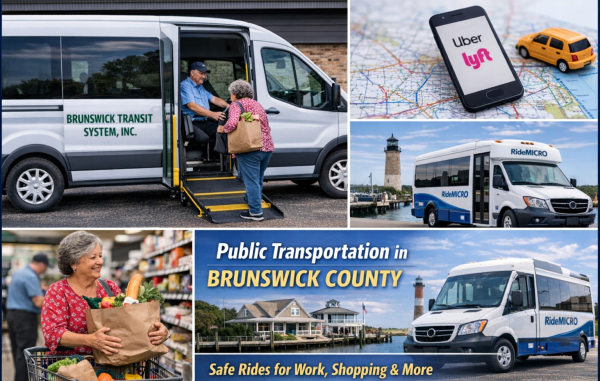
BRUNSWICK COUNTY, NC — Brunswick County relies on a mix of nonprofit, regional, and rideshare services to move residents across one of the fastest‑growing counties in North Carolina. With no county‑run bus system and long distances between communities, transportation access remains a challenge for workers, older adults, and families without reliable vehicles.
Brunswick Transit System, Inc. (BTS) serves as the county’s primary public transportation provider. The nonprofit operates Dial‑A‑Ride service open to all ages and all residents, offering trips for work, medical appointments, shopping, and essential errands. Riders must schedule trips 48 hours in advance, and reservations are taken Monday through Friday during business hours. BTS also contracts with human‑service agencies to transport seniors, individuals with disabilities, and clients of DSS and the Health Department.
Grocery trips are a routine part of BTS service. Riders may bring grocery bags and household items as long as they can carry them and keep them secured at their seat.
Eastern and northern parts of the county are served by RideMICRO, Wave Transit’s flexible microtransit system. The service operates across five zones, allowing riders to request point‑to‑point trips or connect to Wave’s fixed‑route buses in Wilmington. Riders can book through the RideMICRO app or schedule up to one week in advance. Service hours vary by zone but generally include weekday, Saturday, and Sunday coverage.
RideMICRO also allows grocery bags and small household items, provided riders can manage them independently and keep aisles clear.
Rideshare services Uber and Lyft operate in Brunswick County, but availability is inconsistent. Long distances between communities and low driver density mean riders may face extended wait times, especially in rural areas or during off‑peak hours. In beach towns such as Oak Island and Southport, residents report that rides are available but not always immediate, making rideshare a supplemental option rather than a dependable daily service.
Both BTS and RideMICRO follow state transportation safety standards, including driver vetting, vehicle inspections, and accessibility requirements. These systems are designed for the general public, not restricted groups, and are considered safe for riders of all ages. Human‑service transportation for eligible clients operates alongside, not instead of, the general‑public system.
What the County Does Not Operate
Brunswick County Government does not run its own public transportation fleet and does not maintain roads. Most major roadways fall under the North Carolina Department of Transportation, leaving transit services to nonprofit and regional partners.
A Growing County with Limited Transit
As Brunswick County continues to expand, particularly in Leland, Shallotte, and the beach communities, transportation demand is outpacing available services. BTS and RideMICRO provide essential mobility, but the absence of fixed‑route buses and the unpredictability of rideshare options leave many residents dependent on advance scheduling or long waits.
© 2026 BCDollarSaver.com. All rights reserved.


Be the first to comment