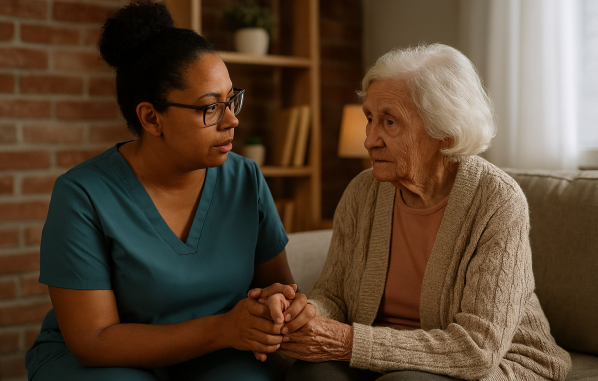
As more Brunswick and Columbus County residents’ step into full‑time caregiving roles, families are seeking clarity on eligibility, support, and how both North and South Carolina handle caregiver pay.
By BC News Staff Writer
Across Brunswick and Columbus counties, more families are stepping into caregiving roles long before they ever expected to. Adult children are rearranging work schedules, spouses are taking on round‑the‑clock supervision, and neighbors are checking in on elders who can no longer manage safely on their own. In many homes, caregiving has become a full‑time responsibility carried out quietly and without fanfare.
As the region’s population ages, one question is surfacing more often: Is there any financial support for families who are providing daily care?
Caregiving in rural communities often means long drives to medical appointments, limited respite options, and the constant worry of leaving a loved one alone. Many families describe the work as an act of love, but also a source of financial pressure. When a caregiver reduces work hours or leaves a job entirely, the household feels the impact immediately.
Local agencies across the region report a steady rise in calls from residents seeking guidance on whether family caregiving can be compensated. Providers such as A New Beginning Home Care Agency (Tabor City), a family‑owned provider serving both Brunswick and Columbus counties, help families understand how caregiver eligibility works under state rules and what steps are involved in functional‑need assessments. Other agencies, including Liberty Homecare & Hospice (Whiteville) and Comfort Keepers (Shallotte) are seeing similar trends.
County offices, including Brunswick County DSS, Columbus County DSS, and local Veterans Services, also note that more residents are asking about caregiver pay as they try to keep loved ones at home.
North Carolina does allow some family caregivers to be paid, but only under specific programs and only when the person receiving care meets the state’s functional‑need criteria. These criteria focus on how much help a person needs with daily tasks such as bathing, dressing, eating, mobility, and medication management. Cognitive conditions—such as dementia or memory loss—also play a major role. To qualify for Medicaid‑funded caregiver pay, the state must determine that the individual would likely require nursing‑home‑level care without in‑home support.
Just across the state line, South Carolina families are navigating similar rules. The state also allows caregiver pay through Medicaid home‑ and community‑based waivers, but like North Carolina the support is limited to specific programs and requires a documented functional need. Many families turn to the South Carolina Department on Aging or their local DSS office for guidance as they work through eligibility questions and long‑term care options. The trend mirrors what is happening in southeastern North Carolina: families throughout the Carolinas are carrying a growing share of long‑term care responsibilities, often with limited financial support.
The emotional weight behind the paperwork — For many families, the assessment process becomes a moment of clarity. It documents what caregivers already know: the work they are doing is essential, demanding, and often nonstop. It also highlights the gap between the level of care required and the resources available to sustain it. In Brunswick and Columbus counties, where “family takes care of family” is more than a saying, the question of caregiver compensation is about more than income. It is about dignity, sustainability, and the ability to keep loved ones safely at home in the communities they know.
Local resources trying to bridge the gap — Organizations such as Brunswick Senior Resources, Inc., Columbus County Aging Services, and local Veterans Services offices help families navigate Medicaid programs, CAP/DA, and veterans’ benefits. Home‑care agencies including A New Beginning Home Care Agency, which guides families through eligibility questions and assessment steps also assist residents in understanding whether a relative may qualify as a paid caregiver under state rules.
Even with these supports, the need continues to outpace the available services. Families are doing their best, but many are stretched thin.
Caregiving has always been part of the fabric of life in southeastern North Carolina. As the region continues to grow and age, the question of how to support those who provide daily care will only become more urgent. Families are carrying a tremendous load, and many are simply looking for a way to keep going.
©2026 BCDollarSaver.com. All rights reserved.


Be the first to comment