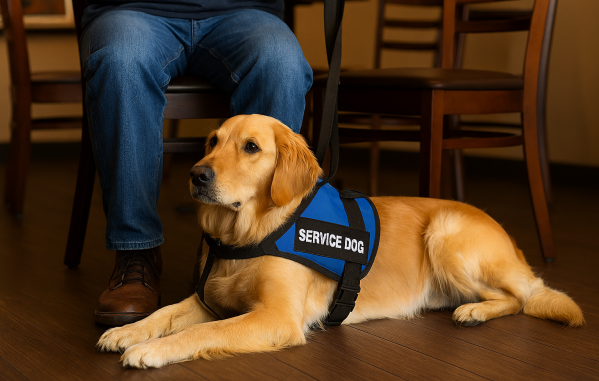
Clear federal rules guide access, but confusion in public spaces remains common
Originally published March 5, Republishing May 5, 2026, due to recent events that involve non-service animals and Southport restaurants.
The State of North Carolina — Service animals are protected under the Americans with Disabilities Act (ADA), which defines a service animal as a specially trained dog or miniature horse that performs tasks directly related to the handler’s disability.
Disability Rights North Carolina notes that emotional support animals and other comfort animals are not considered service animals under federal law and do not receive the same protections.
Service animals are not required to wear vests, carry identification cards, or complete any specific certification program. They may be trained by a professional, an organization, or the handler themselves, as long as the training enables the animal to perform disability‑related tasks. There are no breed or size restrictions for service dogs, and miniature horses used as service animals typically stand 24–34 inches tall, or 6 to 8.5 hands high.
Under the ADA, service animals are allowed in most public places, including restaurants, hotels, government buildings, stores, theaters, and medical facilities.
Staff may ask only two questions when a service animal enters a business: whether the animal is needed because of a disability, and what tasks the animal is trained to perform.
They may not ask about the person’s disability, require documentation, or request a demonstration of the animal’s skills.
Unwritten Rules: Public Etiquette Around Service Dogs
Although federal law outlines access rights, public etiquette is less clearly understood. Handlers often report being approached by strangers asking to pet their dog or commenting on its appearance. These interactions, while often well-meaning, can distract a service animal from its trained tasks. Experts advise that members of the public should not touch, feed, or interact with a service dog unless given explicit permission by the handler. A service dog is considered to be “working” whenever it is with its handler, and interruptions can compromise its focus and effectiveness. The best practice is to speak directly to the handler – not the dog and to respect the team’s space and purpose.
Public Misunderstanding and Visible Judgment
Although federal rules are clear, people who use service animals often encounter public misunderstanding in everyday settings. Handlers report being questioned in restaurants, stores, and waiting rooms when their animal does not fit common assumptions about what a service animal “should” look like. Some bystanders expect a vest, a specific breed, or a certain size, even though none of these are legal requirements. These reactions can create uncomfortable interactions, particularly for individuals whose disabilities are not visible.
The ADA emphasizes that a service animal’s legitimacy is based on training and task performance, not appearance or equipment. Federal guidance directs businesses and the public to rely on the two questions rather than personal assumptions.
When a Service Animal May Be Excluded
A business may exclude a service animal only if the animal is aggressive, unpredictable, or not housetrained. Otherwise, the animal must be permitted to remain with its handler. North Carolina law also grants full access rights to service animals in training, provided they wear a collar, leash, and identifying harness or cape. Trainers are responsible for any damage caused by an animal during the training period.
Information referenced from Disability Rights North Carolina, Legal Guidelines for Service Animals in NC.
© 2026 BCDollarSaver.com. All rights reserved.


Be the first to comment