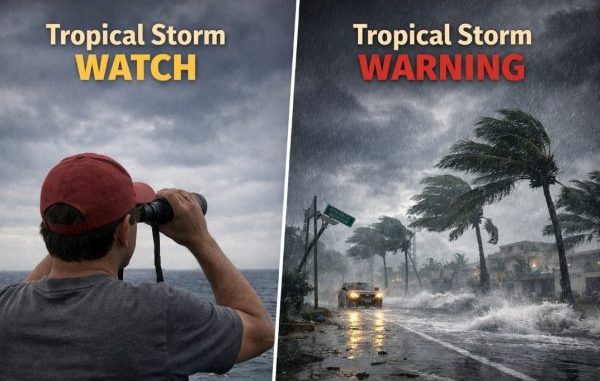
When forecasters say “tropical,” they’re not talking about sunshine and palm trees.
By BC News Staff Writer
As we move further into the 2026 storm season, clarity on weather terminology can be the difference between a minor inconvenience and a major emergency. While residents in our coastal region are no strangers to tropical activity, the National Hurricane Center (NHC) uses specific countdown windows that every household should memorize.
The transition from a WATCH to a WARNING marks the critical shift from “monitoring” to “taking action.”
The Tropical Storm Watch: 48 Hours Out
A Tropical Storm Watch is issued when tropical-storm-force winds (39 to 73 mph) are possible within a specified area. This alert is typically issued 48 hours before the expected onset of hazardous winds.
At this stage, the storm’s path is still subject to shift, but the “Watch” serves as your cue to prepare.
-
Fuel Up: Top off vehicles and generator tanks.
-
Clear the Yard: Secure or move patio furniture, hanging plants, and loose debris that could become projectiles.
-
Stock Up: Verify you have at least three days of water, non-perishables, and fresh batteries.
The Tropical Storm Warning: 36 Hours Out
A Tropical Storm Warning means that tropical-storm-force conditions are expected within the next 36 hours. When a Warning is issued, the window for safe outdoor preparation is rapidly closing.
This 36-hour lead time is calculated based on when it becomes physically dangerous to be outside. Once winds reach tropical-storm strength, it is no longer safe to climb ladders, install shutters, or drive high-profile vehicles across regional bridges.
-
Finalize Protection: Close all shutters and brace exterior doors.
-
Power Prep: Turn refrigerators and freezers to the coldest settings to preserve food in case of a power outage.
-
Stay Informed: Keep a battery-powered weather radio nearby for immediate updates if the grid goes down.
Regional Impact vs. Landfall
A common misconception is waiting for the “eye” of a storm to reach the coast before taking cover. However, tropical-storm-force winds often arrive a full day before the center of the storm makes landfall.
In our area, these types of winds are capable of snapping large tree limbs, downing power lines, and causing significant coastal flooding. Even if a storm is not predicted to become a hurricane, the intensity of a tropical storm demands full respect and preparation.
Stay Weather‑Ready: weather.gov/safety/hurricane‑ww
© 2026 BCDollarSaver.com. All rights reserved.


Be the first to comment