By BC News Staff Writer
COLUMBUS AND BRUNSWICK COUNTIES, NC — The regional drought crisis intensified this week as the latest U.S. Drought Monitor, released Thursday, April 16, 2026, placed 100% of Columbus and Brunswick counties under a Severe Drought (D2) classification. Neighboring Horry County, South Carolina, is also facing deteriorating conditions, with its northern and western sections reaching the same severe status.
The transition to Severe Drought follows a historically dry start to the year.
Precipitation levels for the first quarter of 2026 are nearly six inches below normal across the coastal plain, leaving soil moisture at critical lows and local water tables struggling to recover. State officials announced Thursday that farmers in 85 North Carolina counties, including Columbus and Brunswick, are now eligible for federal disaster relief due to these conditions.

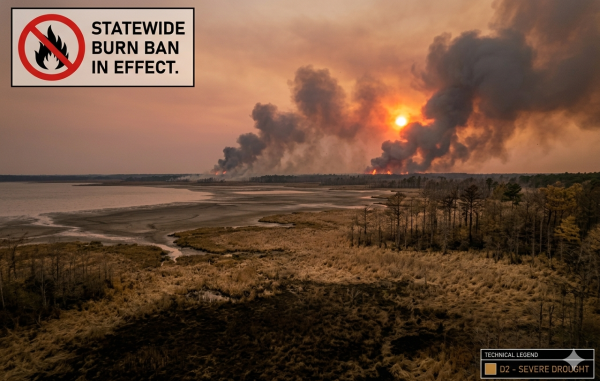
The extreme dryness has fueled a dangerous wildfire season. The Rosindale fire, which ignited April 8 near the intersection of NC 211 and Rosindale Road, has burned approximately 740 acres. While the NC Forest Service reports that the blaze is now 70% contained, smoke and falling ash have been noted across the region from Lake Waccamaw to Cerro Gordo.
In response to the elevated risk, the NC Forest Service continues to enforce a mandatory statewide ban on all open burning. Similarly, Horry County officials initiated an outdoor burn ban on April 8 for all unincorporated areas, citing extreme fire danger caused by low humidity and gusty winds, and starting April 16 a statewide burn ban was put into place.
Local officials are strongly urging residents to eliminate nonessential water usage, such as lawn irrigation and car washing, to preserve municipal supplies. Agricultural impacts are also mounting; with topsoil moisture reported as “short or very short” for over 60% of the state, spring planting and germination have been severely hindered.
Meteorologists with the National Weather Service indicate that relief is unlikely in the immediate future. The short-range outlook through the end of April predicts above-normal temperatures and minimal rainfall, raising concerns that the region could soon join the 30 North Carolina counties already classified as being in Extreme Drought (D3).
© 2026 BCDollarSaver.com. All rights reserved.


Be the first to comment