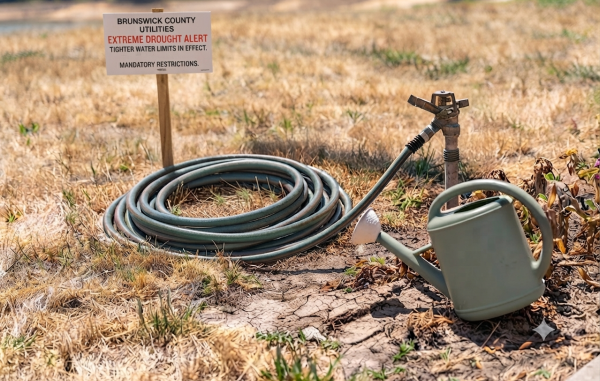
Brunswick’s Stage 3 Water Rules Could Escalate to Maximum Restrictions Under Stage 4. County documents show the full scope of limits, penalties, and enforcement households would face if officials declare a Stage 4 Water Shortage Danger.
Brunswick is in mandatory Stage 3 water conservation
What holds for future households if the Brunswick County government pushes to the maximum Stage 4?
Coastal Carolina News breaks it down.
Brunswick County’s water system remains under strain as Stage 3 conservation rules continue across the region, but county officials warn that a shift to Stage 4 – the highest level of water shortage danger would bring the most restrictive limits residents have ever faced.
Stage 4 is triggered only when water demand exceeds the county’s full 24‑hour treatment capacity, when distribution pressures fall to levels that cannot reliably serve customers, when essential health and safety needs cannot be met, or when the Lower Cape Fear Water and Sewer Authority declares a raw water emergency. Any one of these conditions would force Brunswick County into its maximum response.
Under Stage 4, (Brunswick County is presently in Stage 3) all households would be required to eliminate non‑essential water use. Outdoor irrigation stops entirely, including automatic systems, hose‑end sprinklers, drip irrigation, hand‑held hoses, watering of lawns, shrubs, trees, new plantings, and personal food gardens. Golf courses, erosion‑control projects, and commercial or institutional landscaping also fall under the prohibition. The only exception applies to retail garden centers, which may maintain plant inventory using drip irrigation operated for maximum efficiency.
The county’s restrictions extend beyond irrigation. Washing vehicles of any kind is prohibited, along with washing driveways, sidewalks, patios, and the power‑washing of buildings. Decorative and recreational water uses — including fountains, reflecting pools, artificial waterfalls, misting machines, and ornamental ponds — must shut down. Filling or topping off swimming pools, wading pools, hot tubs, spas, and whirlpool tubs is not allowed. Water use for dust control is prohibited, and sewer line flushing may only occur when necessary to protect public health. Hydrant use is limited strictly to firefighting and approved potable water line flushing.
Indoor water use also tightens under Stage 4. (Brunswick County is presently in Stage 3) Households are directed to use showers rather than bathtubs and limit showers to no more than five minutes. Faucets should not be left running while shaving, brushing teeth, rinsing food, or preparing meals. Residents are encouraged to use disposable and biodegradable dishes where possible. Dishwashers and clothes washers should be used sparingly and only when fully loaded, with dishwashers operated outside peak demand hours between 8:00 p.m. and 4:00 a.m. The county advises inspecting and repairing faulty faucets and toilets, installing water‑saving showerheads, and adding conservation devices such as early‑closing flappers to toilets. Water‑cooled air conditioners are prohibited unless needed to prevent adverse health or safety impacts.
Stage 4 carries a countywide goal of reducing water use by 20%. Wholesale customers, including towns and districts served by Brunswick County must also reduce usage by 20% under their agreements. These reductions may lead to lower system pressures, additional local restrictions, or temporary service interruptions if demand spikes.
Penalties for violating Stage 4 rules escalate quickly. The first offense carries a $200.00 fee, the second rises to $500, and the third results in a $1,000.00 penalty and water disconnection. Any subsequent offense may result in fines up to $5,000 at the discretion of the Director of Public Utilities, along with disconnection.
Enforcement is tied to the county’s ability to monitor system demand and identify prohibited activities that cause measurable increases in usage. Because all homes and businesses are metered, Public Utilities can detect consumption patterns consistent with irrigation, pool filling, or other banned uses. When those spikes appear during a Stage 4 emergency, the county can issue penalties based on documented non‑compliance.
As Brunswick County continues operating under Stage 3, officials emphasize that Stage 4 remains a last‑resort measure. But if raw water conditions worsen or demand exceeds what the system can safely produce, households should be prepared for the full scope of restrictions outlined in the county’s emergency plan.
Coastal Carolina News is the updated branding for bcdollarsaver.com.
© 2026 CoastalCarolinaNews.com. All rights reserved


Be the first to comment