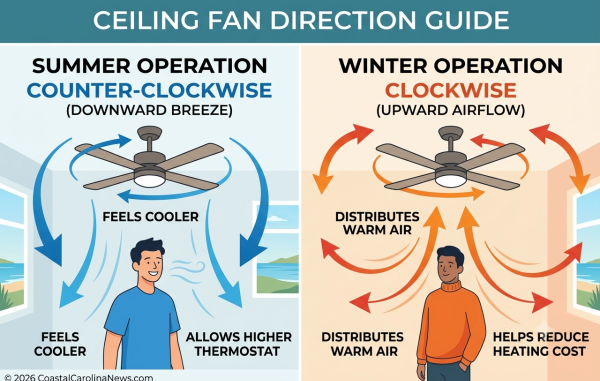
How the right blade rotation can create a cooling breeze without turning down the thermostat.
By Coastal Carolina News Staff Writer
When the humidity rises (and it will) and the summer heat sets in across the Carolinas, the instinct for many homeowners is to immediately crank down the thermostat. However, there is a more energy-efficient way to combat the heat that many residents overlook: the simple, often-neglected ceiling fan switch.
Understanding how to properly utilize your ceiling fan is a game-changer for coastal living, where high humidity often makes the air feel heavy and stagnant. By adjusting your fan’s rotation to match the season, you can create a more comfortable home environment while potentially lowering your monthly utility bills.
The Science of Summer Comfort: The Wind-Chill Effect
Ceiling fans do not actually lower the temperature of a room; instead, they cool people, not spaces. They work by creating a “wind-chill effect.” When a fan rotates counterclockwise, it pushes air straight down. As this air moves across your skin, it accelerates the evaporation of moisture (sweat), which naturally makes your body feel several degrees cooler.
Because you are cooling your body rather than the air in the room, you can set your thermostat a few degrees higher—typically 3 to 4 degrees—without feeling a loss in comfort. This small adjustment can lead to significant energy savings over the course of a hot, humid season.
How to Set Your Fan for Summer
If you are unsure of your fan’s current direction, perform the “look-up” test:
-
Turn the fan on: Stand directly under the blades. If you feel a steady breeze, it is already set to counterclockwise (summer mode).
-
The Switch: If you don’t feel a strong breeze, locate the small toggle switch on the side of the fan housing (below the blades). Flipping this switch will reverse the motor’s direction.
-
Rotation: In the summer, you want the blades to move in a counterclockwise direction when viewed from below.
Maximizing Airflow in Coastal Homes
In Coastal Carolina, where moisture is a constant factor, stagnant air can lead to stuffy rooms and the perception of higher indoor humidity. Proper airflow is essential for mitigating this.
-
Bedrooms: High-speed circulation while you sleep helps dissipate body heat, allowing for a better night’s rest without putting excessive strain on your HVAC system.
-
Living Areas: These high-traffic rooms benefit from “gentle circulation.” Even a low-speed setting creates enough movement to prevent humidity from settling, making open-concept spaces feel much breezier.
-
Porches and Patios: For covered outdoor spaces, a ceiling fan is indispensable. Keeping the air moving creates a barrier that can help deter flying insects while making those humid coastal evenings significantly more enjoyable.
Remember that ceiling fans are “people-coolers.” Because they don’t lower the room temperature, they do nothing to keep a house cool when the room is empty. To maximize your energy savings, make it a habit to turn off the fans when you leave a room.
By taking just a moment to ensure your fans are spinning in the right direction this summer, you can enjoy a cooler, more comfortable home while keeping your energy consumption and your cooling costs under control.
Coastal Carolina News is the updated branding for bcdollarsaver.com.
© 2026 CoastalCarolinaNews.com. All rights reserved.


Be the first to comment