Digital currency’s rise leaves local residents asking how – and whether – it fits into everyday life
By BCNews Staff Writer
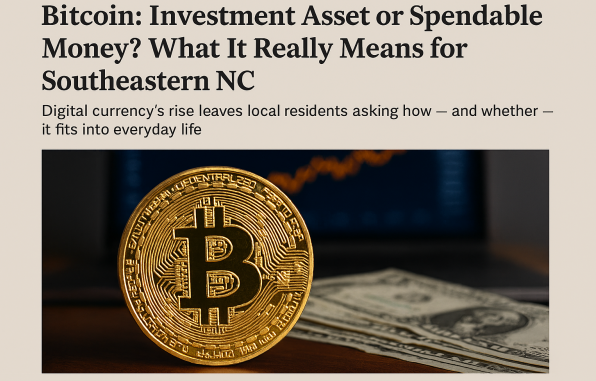
Bitcoin has become one of the most talked‑about financial tools in the world, but for residents of Brunswick, Columbus, and neighboring Horry County, its real‑world use looks very different from the hype. While the digital currency was originally designed to function like electronic cash, it now operates far more like an investment asset than a spendable form of money, especially in North Carolina where regulations are strict and local acceptance remains limited.
Bitcoin was created in 2008 by an anonymous developer known as Satoshi Nakamoto, who introduced it as a decentralized alternative to traditional banking. Instead of relying on a central authority, Bitcoin transactions are recorded on a public ledger called a blockchain and secured through a process known as mining. Only 21 million bitcoins will ever exist, a built‑in scarcity that has helped fuel its value and attract investors around the world.
For most North Carolina residents, Bitcoin serves primarily as a digital investment asset, not a day‑to‑day spending tool. State law requires cryptocurrency companies to obtain a money transmitter license, a hurdle that limits which platforms can operate here. As a result, many people invest through large, regulated exchanges such as Coinbase or Kraken, or through financial products like Bitcoin‑linked ETFs. Others buy small amounts through Bitcoin ATMs, which are common in gas stations and convenience stores across southeastern NC, though these machines often carry high fees and have been repeatedly linked to scam activity.
Cashing out works much the same way. Investors typically sell their Bitcoin back through an exchange and transfer the proceeds to a bank account. Some ATMs allow users to convert Bitcoin to cash, but the fees are steep and law enforcement warns that these machines are frequently used in fraud schemes. Because Bitcoin transactions cannot be reversed, victims who send funds to scammers have no recourse.
When it comes to spending Bitcoin locally, options are limited. A handful of small businesses and private service providers may accept it directly, but this is the exception rather than the rule. Most major retailers, utilities, medical providers, and government offices do not accept cryptocurrency. In practice, residents who want to “spend” Bitcoin usually do so through workarounds such as crypto‑linked debit cards or gift card conversions offered by companies like BitPay or Coinbase. These tools convert Bitcoin into dollars at the moment of purchase, allowing users to shop anywhere Visa or Mastercard is accepted, even though the business itself never handles cryptocurrency.
The tourism‑driven economy in nearby Horry County offers slightly more flexibility. Myrtle Beach has more Bitcoin ATMs and a small number of shops and vacation rentals that accept digital payments, largely due to international visitors and tech‑savvy travelers. Still, even there, Bitcoin functions more as a novelty payment option than a mainstream currency.
Local law enforcement agencies across North Carolina continue to warn residents about scams involving Bitcoin, particularly those in which victims are instructed to pay bills, fines, or fees using a Bitcoin ATM. No legitimate agency or business will ever demand cryptocurrency as payment, a message repeated frequently in Brunswick and Columbus counties as these scams continue to circulate.
For now, Bitcoin remains primarily an investment vehicle for southeastern North Carolina residents. It is accessible, increasingly popular, and easy to buy, but it is not liquid cash in the traditional sense. While it can be converted and spent through various tools, it is rarely accepted directly, and its volatility and tax implications make it impractical for everyday transactions. As interest grows and regulations evolve, Bitcoin’s role in the region may change, but today it sits firmly in the category of digital asset rather than daily currency.
©2026 bcdollarsaver.com. All Rights Reserved.


Be the first to comment