By BC News Staff Writer
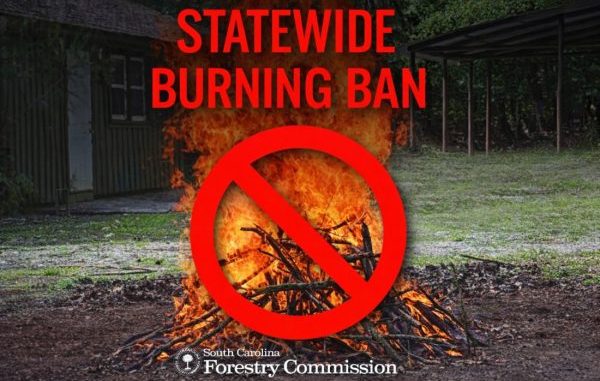
April 13, 2026 — As a record-breaking dry spell grips the Carolina coast, fire officials are warning residents that our region is currently a “tinderbox.” The statewide burn ban issued by the NC Forest Service on March 28 remains firmly in place, and as of last week, Horry County initiated its own emergency outdoor burn ban for all unincorporated areas.
With zero rainfall in the immediate forecast and humidity levels plummeting, local fire marshals stress that even a “tiny spark” could trigger a catastrophe similar to the 20-acre wildfire that threatened structures in Winnabow just days ago.
No Open Burning: A Zero-Tolerance Policy
The current mandates across Brunswick, Columbus, and Horry counties are clear: all open burning is strictly prohibited.
This includes:
- Yard Debris: No burning of leaves, branches, or vegetative matter.
- Recreational Fires: No campfires, bonfires, or fire pits, even in residential backyards.
- Canceled Permits: All previously issued burning permits are void, and no new permits will be issued until the drought breaks.
The Hidden Danger: Tossed Cigarettes
Fire officials are issuing a specific plea to motorists and pedestrians be wise with your tossed cigarettes. In these extreme conditions, a discarded butt is not just litter—it is a live ignition source.
When fuel bed moisture drops below ten percent – as it has in our region – the probability of a cigarette butt igniting dry grass or pine needles increases significantly with every gust of wind. These fires often begin as slow “smolders” that go unnoticed by early detection systems, only to erupt into uncontrollable blazes once they reach a disaster scale.
AI “Eyes and Ears” in the Forest
Technology is being deployed across the tri-county area to provide early warnings and enhance emergency response:
- “Electronic Noses”: AIoT (Artificial Intelligence of Things) sensors are being placed in high-risk zones like the Green Swamp. These sensors can “smell” the chemical signature of a fire before smoke is visible to the human eye.
- Satellite Mapping: AI algorithms scan high-resolution satellite imagery every few minutes, pinpointing thermal “hot spots” typical of a brush fire ignition.
- Digital Twin Simulations: Emergency planners are using 3D “Digital Twin” models of our local landscape to predict exactly how a fire would move through neighborhoods in Bolivia, Whiteville, or Loris based on today’s specific wind gusts.
The Legal and Financial Stakes
Violation of the burn ban is a serious offense. In North Carolina, violators face a mandatory $100 fine plus $183 in court costs. Furthermore, under both NC and SC law, any person responsible for an illegal fire can be held liable for the total cost of the emergency response, which can quickly reach tens of thousands of dollars.
REPORT ALL SMOKE IMMEDIATELY BY DIALING 9-1-1
© 2026 BCDollarSaver.com. All rights reserved.


Be the first to comment