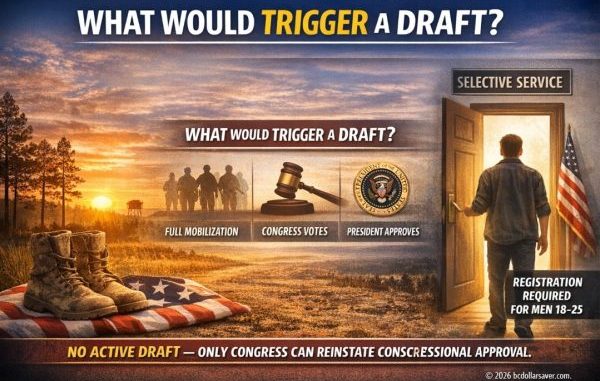
There is no active draft, and federal law requires multiple steps before conscription could ever return
As global tensions rise and new Army enlistment rules take effect this spring, questions about the military draft are resurfacing across southeastern North Carolina. Families in Columbus, Brunswick, and Horry counties are asking whether the United States could ever bring back conscription and what that would mean for the communities here at home.
Despite the renewed attention, the United States remains an all‑volunteer force, and a draft cannot begin without a series of deliberate actions by both Congress and the President. Even a prolonged overseas conflict does not automatically trigger conscription.
Under federal law, a draft is considered only after the military has fully used its existing manpower. That includes active‑duty soldiers, the Army Reserve, the National Guard, and the Individual Ready Reserve. These forces must be mobilized through existing authorities before Congress can even debate reinstating conscription.
Only if those resources are exhausted and the military still cannot meet operational needs can lawmakers vote to activate the Selective Service System. The President must then sign the authorization, making a draft the final step in a long chain of federal decisions.
If a draft were ever reinstated, the impact would be felt immediately at the local level. Selective Service boards assigned to Columbus, Brunswick, and Horry counties which currently exist only on paper would be staffed and activated. These boards are responsible for reviewing deferments, exemptions, and hardship cases, meaning decisions about local residents would be made by community members appointed to serve in those roles. The Selective Service System maintains the structure for this process, but it remains dormant unless Congress orders it into operation.
Although the draft ended in 1973, the requirement to register for Selective Service never disappeared.
Men are still legally required to register within 30 days of turning 18, and failure to do so can affect federal student aid, government employment, and other benefits. Beginning in December 2026, federal law will shift to automatic registration using DMV and Social Security records. This change does not activate a draft; it simply modernizes the registration process and reduces paperwork for young adults.
Recent updates to Army Regulation 601‑210 including raising the maximum enlistment age to 42 have added to public curiosity about military manpower.
Recruiters across Southeastern North Carolina report increased questions from both families and potential enlistees. Still, officials emphasize that the United States remains an all‑volunteer force, and a draft would require multiple layers of federal action, none of which are currently underway.
For now, the Selective Service System continues to operate quietly in the background, maintaining a database that would only be used if Congress and the President jointly decide to reinstate conscription. Until that happens, local families can expect the nation’s military to remain volunteer‑based, as it has for more than five decades.
© 2026 BCDollarSaver.com. All rights reserved.


Be the first to comment