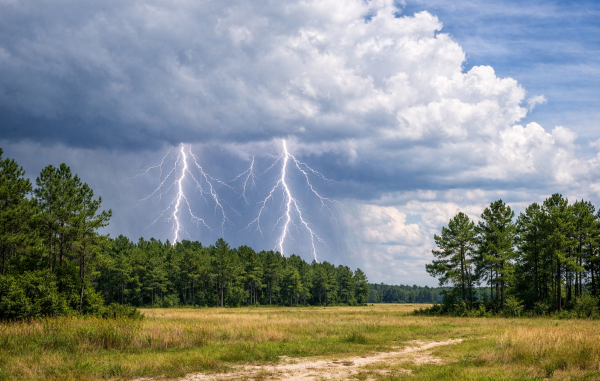
NC Forest Service cites verified strike data and drought‑driven “holdover fire” behavior as residents question the cause on social media
Shallotte, NC — The NC Forest Service has confirmed that the wildfire near Quarry Road and Old Georgetown Road in Shallotte was caused by a lightning strike, a determination made through verified lightning‑strike data and physical burn‑pattern evidence. The announcement comes as social‑media speculation continues to circulate, with some residents insisting the fire must have been caused by land clearing, a controlled burn, or human activity.
Investigators found that lightning ignited organic material beneath the surface, where dry roots, duff, and peat layers can hold heat long after a storm has passed. In periods of Exceptional Drought (D4), such as the conditions currently affecting Brunswick County, underground smoldering becomes far more likely. When oxygen eventually reaches the smoldering pocket, the fire can break through the surface hours or even days after the actual lightning strike. This type of ignition, known as a holdover fire, is a standard operating definition used by the NC Forest Service and federal wildfire agencies to classify fires during extreme drought conditions.
Despite the Forest Service’s findings, disbelief spread quickly online. Some commenters insisted the fire had to be human‑caused because they did not see lightning in the area. One resident wrote, “I was 2 miles away, wasn’t a cloud in the sky till late that evening,” while others labeled the lightning determination as “fake news.” Several posts claimed the fire was started by nearby development or a controlled burn, though investigators found no evidence of equipment, debris piles, burn activity, or any human ignition source in the area.
Wildfire officials emphasize that visible weather conditions at the time a fire becomes noticeable do not indicate when the ignition occurred. Lightning does not need to be seen by residents to cause a wildfire, and cloud‑to‑ground strikes can occur from distant storm cells, without rainfall, thunder, or visible flashes.
The Forest Service relies on instrumented lightning‑detection data rather than eyewitness accounts to determine cause, and the Shallotte fire’s ignition pattern matched a lightning strike rather than any human activity.
Exceptional drought has left underground organic material extremely dry throughout Brunswick County, creating conditions where lightning‑caused smoldering can persist unnoticed. The Shallotte wildfire’s delayed emergence, underground ignition, and rapid spread are consistent with drought‑driven lightning fires documented throughout the Southeast.
Despite the rumors circulating online, the NC Forest Service’s investigation concludes that the Shallotte wildfire was ignited by lightning, likely from a strike occurring days before the fire became visible. The agency’s findings align with established wildfire science and the extreme drought conditions currently affecting the region.
Standard Disclosure: Coastal Carolina News provides factual reporting based on public records, official incident logs, and statements from local, county, and state agencies. We believe our readers deserve the truth as documented by the authorities responsible for our community’s safety.
If you have evidence that contradicts an official record, we invite you to share it with us. We encourage residents to use the official records we cite as the starting point for any questions regarding municipal or county actions.
Coastal Carolina News is the updated branding for bcdollarsaver.com.
© 2026 CoastalCarolinaNews.com. All rights reserved


Be the first to comment