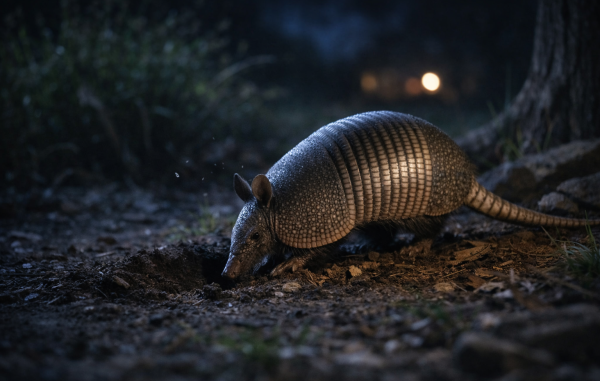
Wildlife officials confirm the species is now a permanent part of the eastern Carolinas, with residents reporting nighttime activity, lawn damage, and burrows across the tri‑county region.
By Coastal Carolina News Staff Writer
SHALLOTTE, NC — Armadillos, once considered rare in the Carolinas, are now firmly established across Brunswick County, Columbus County, and Horry County, according to wildlife officials in both states. The nine‑banded armadillo’s steady eastward movement has accelerated over the past decade, making the species a new and permanent part of the region’s wildlife landscape.
The North Carolina Wildlife Resources Commission (NCWRC) reports confirmed armadillo presence in 42 of the state’s 100 counties, with southeastern North Carolina now considered a primary foothold.
Brunswick County has documented consistent sightings from Calabash and Ocean Isle Beach to Bolivia, Ash, and the Shallotte area. Horry County SC, has recorded countywide establishment, including Conway, Loris, Longs, Socastee, and Carolina Forest.
Columbus County, positioned between these two high‑activity zones, is now part of the expected range. Residents have reported digging patterns, disturbed soil, and nighttime movement consistent with armadillo behavior. Wildlife biologists say the county is likely already supporting a stable population.
Armadillos were first confirmed in North Carolina in 2007, when one was documented in Macon County. Sporadic sightings continued through the 2010s before the expansion accelerated around 2019 to 2021. By 2023 to 2024, Brunswick and Horry counties were fully established, and Columbus County entered the expected range shortly afterward.
Armadillos are nocturnal and typically active between midnight and dawn. Most residents never see the animals directly but notice the signs they leave behind. These include small conical holes in lawns, disturbed mulch or pine straw, and burrow openings roughly seven to 8 inches wide. Tracks may appear in sandy soil, though they are often faint.
The animals are ground‑dwelling and do not climb. They move low to the ground with a slow, waddling gait, using their long, pointed snout to root for insects. Their diet consists primarily of beetles, grubs, larvae, earthworms, ants, termites, cockroaches, and fire ant larvae. They may occasionally consume very small snakes, geckos, or frogs if uncovered while digging, but they do not hunt or pursue prey.
Armadillos are not aggressive and do not attack people or pets.
When startled, they typically freeze, jump straight up, and then flee. Wildlife officials advise residents not to handle armadillos, alive or dead, due to a small but documented risk of leprosy transmission through direct contact. The odor associated with armadillos is mild and musky, usually only noticeable at close range or in burrows.
While armadillos are non‑native to the Carolinas, they are not classified as an invasive species.
Wildlife agencies describe them as natural range expanders rather than ecological threats. Their impact is considered nuisance‑level: lawn damage, disturbed landscaping, and occasional burrows under sheds or brush piles. They do not significantly harm native wildlife or ecosystems.
Armadillos are not a protected species in North Carolina or South Carolina. They are not considered game animals, are not hunted for sport, and have no special legal protections. Removal is permitted under state wildlife regulations if they cause property damage, though officials continue to discourage handling due to disease concerns.
The species has few natural predators in the region. Coyotes, bobcats, and domestic dogs may occasionally prey on armadillos, but their armored plates make them difficult targets. Most armadillo deaths occur from vehicle strikes, cold weather, or habitat disturbance rather than predation.
Residents who encounter armadillos may send photos and location details to the North Carolina Wildlife Resources Commission at wildlifehelpline@ncwildlife.org or through the contact form at ncwildlife.org
Coastal Carolina News is the updated branding for bcdollarsaver.com.
© 2026 CoastalCarolinaNews.com. All rights reserved


Be the first to comment