Younger adults report rising cases, while older adults face the highest financial losses
As Valentine’s Day approaches, the North Carolina Department of Information Technology is urging residents to stay alert for online romance scams, a fast‑growing form of cybercrime that continues to cost Americans significant amounts of money and personal data.
According to the Federal Trade Commission, Americans reported losing more than $1.3 billion to romance scams between 2017 and 2021. Reports among adults ages 18 to 29 increased tenfold during that period, while adults over 70 experienced the highest median losses at $9,000.
Romance scammers typically create fake online profiles, build emotional connections, and then manipulate victims into sending money or sharing sensitive information. These schemes often unfold on dating apps, social media platforms, email, and messaging services.
How to Protect Yourself Online
Share With Care
NCDIT recommends thinking carefully before posting personal details online. Public information — including hobbies, family, travel, and relationship status — can help scammers tailor their approach. Officials suggest using an alternate persona for dating profiles to limit exposure.
Check Your Account Settings
Setting social media accounts to private makes it harder for scammers to gather information or initiate contact. Public profiles allow criminals to easily scan old posts, photos, and personal history.
Think Before You Act
Be cautious of messages that:
- push for immediate action
- ask for personal or financial information
- come from unfamiliar senders
Never share sensitive information through email unless you are certain of the recipient’s identity.
When in Doubt, Throw It Out
Links in emails, texts, posts, and ads are common tools for cybercriminals. Avoid clicking unexpected links or downloading attachments from unknown sources.
Use Reverse Image Search
If you’re unsure whether someone is who they claim to be, run their profile photo through a reverse image search.
Recommended tools include:
- Bing Visual Search
- Google Image Search
- Reverse Image Search
- TinEye
These tools can reveal whether a photo belongs to someone else or appears across multiple fake profiles.
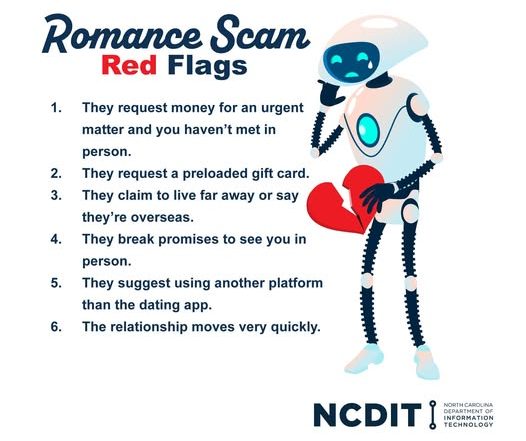 Red Flags to Watch For
NCDIT warns residents to be cautious if someone:
- asks for money for an “urgent” situation
- requests payment through gift cards or other hard‑to‑trace methods
- claims to live overseas or be deployed in the military
- professes love unusually quickly
- pressures you to move conversations off the platform
- repeatedly cancels plans to meet in person
What To Do If You Suspect a Scam
Officials recommend taking the following steps immediately:
- Stop communication with the scammer
- Document everything, including email addresses, messages, and screenshots
- Contact your bank if you sent money
- Report the scam to the FTC and the FBI
- Notify the website or app where you met the scammer
© 2026 bcdollarsaver.com. All Rights Reserved.


Be the first to comment