
USGS confirms high-altitude shockwave near Columbia, but military and scientific agencies disclaim responsibility
By BC News Staff Writer
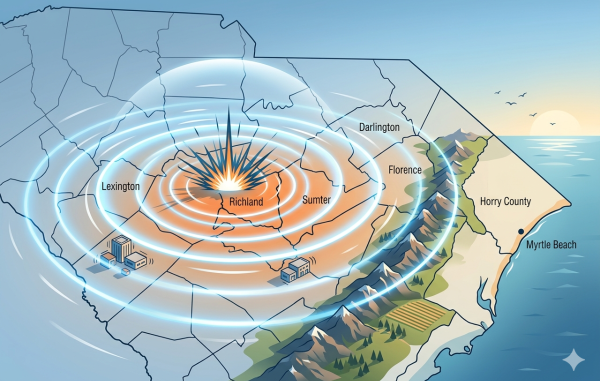
COLUMBIA, SC — A powerful, unexplained shockwave rattled windows and shook walls across the South Carolina Midlands late Thursday afternoon. While the concussive energy triggered frantic calls to emergency dispatchers from North Augusta to Sumter, the sound from the Midlands sonic boom did not reach the coast.
The acoustic wave traveled roughly as far east as Darlington and Florence counties before dissipating, fading out well before hitting the Horry County line.
The United States Geological Survey (USGS) officially logged the event on Thursday, May 28, 2026, at 5:24 p.m. EDT. Classified as a Magnitude 0.0 Sonic Boom, seismologists pinned the primary acoustic impact near Saint Andrews in Richland County. Because the shockwave originated high in the atmosphere, the localized pressure wave easily bridged county lines to impact the broader metropolitan area, though federal officials have yet to identify the exact source behind the disruption.
Military and scientific entities quickly distanced themselves from the incident. Fort Jackson officials stated the blast did not stem from ongoing training operations, and the South Carolina Air National Guard confirmed none of its units were responsible. Shaw Air Force Base did not immediately claim an aircraft-generated boom. Additionally, NASA and the American Meteor Society reported no definitive tracking of daytime meteor or fireball activity over the region.
Federal agencies continue to review regional aviation and atmospheric data, but the true origin of the Midlands boom remains officially unresolved.
© 2026 BCDollarSaver.com. All rights reserved.


Be the first to comment