
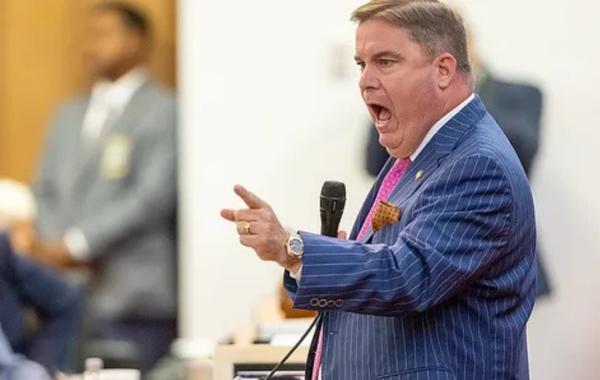
Raleigh, NC – Rep. Brenden Jones urges Treasurer Briner to suspend Non-Preferred classification of rural hospitals before January 2027 rollout
North Carolina House Majority Leader Brenden H. Jones is pushing back hard against a newly approved provider-tier structure under the State Health Plan, warning that the policy — set to take effect Jan. 1, 2027 — could devastate rural hospitals, force patients away from their longtime physicians and quietly accelerate the consolidation of North Carolina’s health care market.
In a letter dated Aug. 6, 2026, addressed to State Treasurer Brad Briner, Jones argued that the restructured plan — developed in partnership with Blue Cross Blue Shield — will classify health care providers into four tiers: Preferred, Access, Non-Preferred or Out-of-Network — with members paying significantly more for care received at Non-Preferred facilities.
The concern cuts especially close to home for Columbus County. Under the current structure, Columbus Regional Healthcare System — the county’s primary hospital — has been designated Non-Preferred, while UNC Health and Novant facilities in surrounding counties hold Preferred status. That means state employees and retirees in Columbus County would face a stark choice: pay higher out-of-pocket costs to receive care close to home or drive farther to access cheaper in-network care.
“Rural North Carolinians should not be sacrificed to improve a spreadsheet in Raleigh,” Jones wrote.
A Policy That Creates Winners and Losers
Jones argued the State Health Plan is using its enormous purchasing power to steer patients — and revenue — toward select large health systems, putting rural and independent hospitals at a structural disadvantage they did not create and cannot easily overcome.
He warned the consequences could unfold gradually, rather than all at once.
“A rural hospital does not have to close its doors for a community to lose meaningful health care,” Jones wrote. “It can eliminate obstetrics, stop performing surgeries, lose specialists, reduce inpatient capacity, and become little more than an emergency room and a transfer station. That is how rural health care is dismantled: one patient, one physician, and one service at a time.”
Jones also raised the issue of hospital consolidation, arguing that when the state redirects patients and revenue toward preferred systems, rural hospitals face mounting pressure to cut services, affiliate or sell — not because of market forces, but because of financial pressure created by state policy.
A Personal Dimension
Jones made his case personal as well. He noted that his own wife underwent major surgery and requires ongoing care, illustrating the real-world difficulty of forcing patients to abandon established physician relationships simply to avoid higher costs — a burden that falls disproportionately on rural residents who already face longer travel distances, fewer specialists and limited transportation options.
What Jones Is Asking
The majority leader stopped short of calling for the plan to be scrapped entirely, acknowledging the need to control costs and protect the financial stability of the State Health Plan. But he called the current structure deeply flawed in how it distributes those cost savings.
Jones is urging Treasurer Briner and the Board of Trustees to:
- Reverse the Non-Preferred classification of rural hospitals before the January 2027 effective date
- Suspend the Non-Preferred designation for rural hospitals until the state can demonstrate that comparable care is genuinely available within a reasonable travel distance
- Establish meaningful continuity-of-care protections for patients already receiving treatment from affected providers
- Meet with legislators to halt implementation until the full consequences for rural patients, physicians and hospitals are examined
“I understand the need to control costs,” Jones wrote. “But a policy that produces savings by forcing rural members to travel farther, abandon their physicians, and weaken their local hospitals does not truly reduce costs. It transfers those costs onto patients, families, local economies, and entire communities.”
As of Friday, the Treasurer’s office had not issued a public response to Jones’ letter.
Editor’s note: Representative Jones represents the 46th District, which includes Columbus County.
© 2026 CoastalCarolinaNews.com. All rights reserved


Be the first to comment