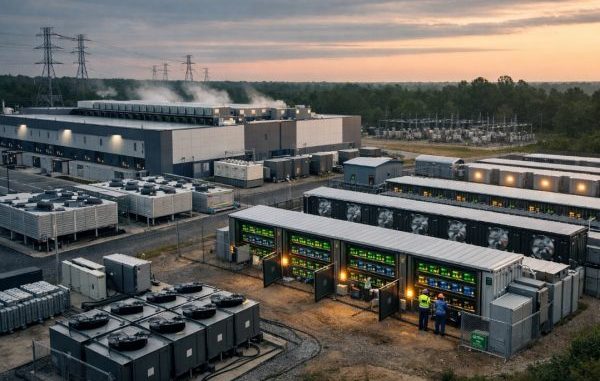
Local governments across Brunswick County adopt new rules, buffers, and temporary moratoriums as digital‑infrastructure proposals increase.
By Coastal Carolina News Staff Writer
Brunswick County, NC — Municipalities in Brunswick County are taking coordinated steps to regulate data‑center development as interest in large‑scale digital infrastructure continues to rise across southeastern North Carolina. Towns including Leland, Shallotte, Boiling Spring Lakes, and Southport have each advanced new ordinances or temporary moratoriums aimed at defining where data centers can operate and what impacts must be reviewed before approval.
Leland updated its Unified Development Ordinance to formally define data centers and restrict them to conditional zoning within the town’s Innovation District. The change requires case‑specific review of noise, water use, energy demand, and separation from residential areas. Town officials said the update ensures high‑intensity digital facilities align with long‑term land‑use planning.
Shallotte adopted its own standards by placing data centers within the industrial and manufacturing district and requiring buffers between any proposed facility and homes, schools, daycares, assisted‑living centers, parks, and active agricultural land. Planning staff noted the rules were designed to protect community character while still allowing advanced technology uses in areas suited for heavy operations.
Boiling Spring Lakes enacted a 12‑month moratorium covering data centers, data‑processing facilities, and cryptocurrency‑mining operations. The city cited concerns about infrastructure strain, environmental impacts, and the lack of clear definitions in its existing ordinances. Officials plan to use the pause to evaluate noise thresholds, electrical load, water consumption, and long‑term site management.
Southport’s Planning Board has recommended a moratorium of up to 15 months while the city drafts new rules of its own. Discussions have included electromagnetic‑field monitoring, PFAS and PFOA considerations, water‑use limits, energy‑impact reviews, and decommissioning requirements for large‑scale digital facilities. The recommendation now moves to the Board of Aldermen for consideration.
Together, the actions show a countywide trend: Brunswick County towns are working to get ahead of data‑center proposals before they arrive at full scale.
As digital‑infrastructure companies expand across the Carolinas, local governments are balancing economic opportunity with land‑use compatibility, environmental safeguards, and long‑term community planning.
© 2026 CoastalCarolinaNews.com. All rights reserved.


Be the first to comment