
Harmless, fast, and often misunderstood, these common reptiles play an important role in southeastern North Carolina’s ecosystem.
CAROLINA SHORES, NC — Homeowners across Brunswick and Columbus counties are noticing the same quick flash of color on porches, decks, and garden beds this time of year as a streak of bright blue disappears under a board or darts across a walkway. That flash belongs to the five‑lined skink, one of the most common and most misidentified reptiles in the region. Despite persistent local myths, skinks are not venomous, not poisonous, and not harmful to people or pets.
They are shy, beneficial neighbors that help control insect populations around homes and wooded areas.
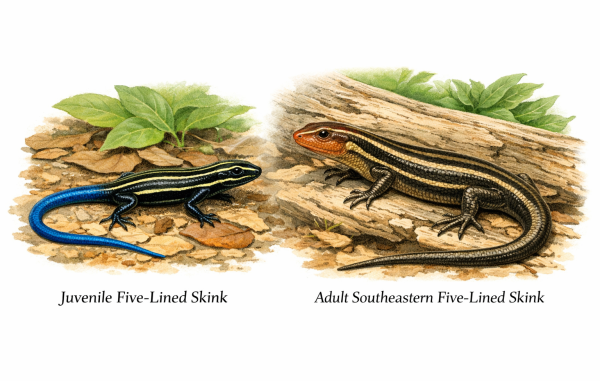
The familiar blue tail that catches so many eyes belongs mostly to juveniles. Their bodies are dark with five pale stripes, and their tails are a vivid, almost neon blue that fades as they mature. North Carolina hosts three similar striped skink, the five‑lined skink, the southeastern five‑lined skink, and the broadhead skink and all three begin life with blue tails, which leads to frequent confusion among residents who assume they are seeing a single species.
Size differences add to that confusion, since most skinks seen around homes grow only five to eight inches long, while the broadhead skink can reach eight to thirteen inches, with some males approaching fourteen.
These larger males develop wide, muscular heads that turn orange‑red during breeding season, causing many residents to believe the small blue‑tailed juveniles grow into the big red‑headed adults. In reality, they are different species that simply look similar when young.
Skinks are also known for their dramatic escape tactic, dropping their tails when threatened. This behavior, called autotomy, allows the tail to detach and thrash on the ground while the skink sprints away. The tail does grow back, though the regenerated version is usually shorter, duller in color, and made of cartilage rather than bone. Juveniles that lose their bright blue tails often regrow a tail that is gray or brown. The ability to shed the tail helps skinks survive predators common in the region, including snakes, birds, raccoons, and outdoor cats.
Concerns about pet safety surface frequently, but skinks are not poisonous or venomous to cats or dogs, according to NC State University’s College of Veterinary Medicine and the NC Wildlife Resources Commission. A cat that eats a small reptile may occasionally develop stomach upset or, more rarely, a parasite‑related illness, a pattern noted in the Merck Veterinary Manual and by VCA Animal Hospitals. These cases are uncommon in North Carolina and are not toxin‑related, and most cats show no symptoms at all, a point also supported by the Pet Poison Helpline.
Skinks thrive in both natural and residential areas, favoring fallen logs, stumps, woodpiles, rock piles, older structures, and shaded porches. They spend much of their time under cover, emerging to bask or hunt insects on warm days. Their diet includes spiders, beetle larvae, crickets, roaches, and other arthropods, making them a natural form of pest control and a sign of a healthy habitat with abundant ground cover and insect life. They are classified as nongame wildlife in North Carolina and collecting them without proper licensing is restricted.
Though often overlooked or mistaken for something dangerous, skinks are harmless, ecologically valuable reptiles that share space with residents throughout Brunswick and Columbus counties. For many homeowners, learning what these blue‑tailed streaks really are turns a moment of surprise into a deeper appreciation for the wildlife living just outside the door.
Disclaimer: BC News provides general information drawn from wildlife and veterinary authorities. It should not be interpreted as medical, legal, or professional advice. Individuals with specific questions should seek assistance from a qualified expert.
© 2026 BCDollarSaver.com. All rights reserved.


Be the first to comment