MATTHEWS — The North Carolina Department of Agriculture and Consumer Services has confirmed the first established presence of the invasive yellow‑legged hornet (Vespa velutina) in the state after multiple adults were found near the Union–Mecklenburg county line.
The initial report came from a Union County homeowner who noticed unusual hornet activity at her hummingbird feeder. NCDA&CS investigators responded and located additional hornets in the surrounding area. Survey and trapping operations are now underway in coordination with USDA‑APHIS‑PPQ.
Dr. Bill Foote, director of the NCDA&CS Plant Industry Division, said the agency has been monitoring for the species since it was first detected in Savannah, Georgia, in November 2023. The hornet, an aggressive predator of honeybees and other pollinators, had remained localized in Georgia and South Carolina until a population was identified last December in York County, S.C.
“This detection prompted us to ramp up surveillance this year in southern Union and Mecklenburg counties,” Foote said. “North Carolina has thousands of beekeepers statewide, and our apiary team has been working diligently to alert them to the threat yellow‑legged hornet poses to their hives.”
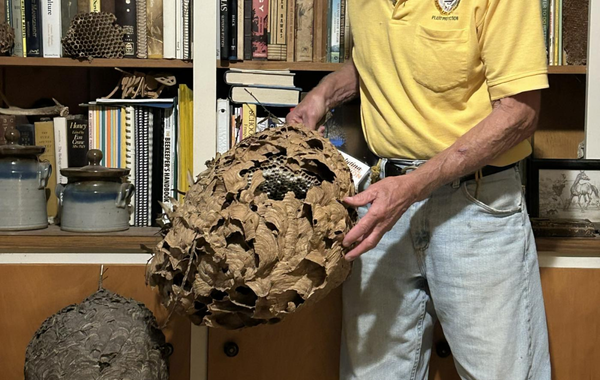
Beekeepers are being asked to watch for hornets exhibiting “hawking‑like behavior,” a hunting pattern in which hornets hover outside a hive and prey on bees as they return. Officials say the hornet’s nests are also distinctive, often reddish or muddy in color and capable of growing far larger than typical hornet nests. At this point in the season, a nest would likely be about the size of a volleyball but can expand to fill the bed of a pickup truck.
State Apiarist Don Hopkins said the hornet poses a serious threat to honeybee colonies. “Because yellow‑legged hornets attack honeybees, they can cause reduced foraging and colony failure,” Hopkins said. “This would result in reduced honey and other honeybee products, reduced crop production due to decreased pollination by honeybees and native pollinators.”
NCDA&CS crews are working to locate and remove the nest to prevent further spread. More than 200 survey traps have been placed around the Matthews neighborhood where the hornets were spotted.
Homeowners and beekeepers statewide are encouraged to visit ncagr.gov/YLH for instructions on building, reporting and monitoring traps on their property.
© 2026 CoastalCarolinaNews.com. All rights reserved


Be the first to comment